

Partners ·
Deepfake CFO fraud prevention with Halo and a Pokee agent
Deepfake CFO fraud prevention: Halo flags a synthetic face and, in our design, a Pokee agent holds the payment. Firms reported $30M in AI-linked BEC in 2025.
DRAFT for review — not published.

By Xingyu (Alex) Shen, Founding Engineer, Scam AI
When a payment request arrives mid-call, Scam AI and Pokee AI's design for deepfake CFO fraud prevention puts an agent between the request and the money. On a late call, a financial controller hears her CFO ask her to pay a regular supplier at new bank details tonight and to keep it off the finance thread. Halo flags the synthetic face, and a Pokee agent on the same laptop holds the payment until the real CFO confirms.
A warning alone tells her the face may be synthetic, yet leaves her with the next step, under the pressure the caller created.
At a glance
- Who: finance teams that approve payments on calls. Pokee AI builds enterprise agents that can run on the device; Scam AI makes Halo.
- The use case: a deepfaked executive asks for a payment mid-call; the warning reaches an agent that holds it until the real executive confirms.
- The split: Halo flags the face, Pokee's agent checks the request within its permissions, and people release or cancel.
- The demo: a crop of a generated face, the kind a warning carries, flagged by our detection, then the agent's designed hold, step by step.
- Available today: Halo and Pokee's agents run now. Halo's hand-off to an agent is built in, off by default and switched on per customer; the payment hold is designed with Pokee.
Why deepfake CFO fraud prevention has to happen mid-call
The pattern is old: urgency, secrecy and a new account. The FBI files it under business email compromise, which drew 24,768 complaints and $3.05 billion of reported losses in 2025 (IC3 2025 report). Businesses reported more than $30 million of that year's losses in schemes involving AI.
What is new is a face on the call making the request. "Keep it off the thread" removes the colleague who would normally notice, so the check has to arrive inside the call, and someone has to act on it.
Halo can tell that a face on the call is generated or swapped (meeting deepfake protection), but it cannot check a vendor record or stop a payment. An agent can do both but cannot see the face, so here the job of acting on the warning before the call ends goes to the agent.
The two companies first appeared side by side at COMPUTEX 2026, on Qualcomm's stand (Dennis Ng on LinkedIn). At Snapdragon Summit 2026, Qualcomm described the pairing as a "Secured Enterprise Agent" demo (OnQ).
From the flag to the hold
Stages one to three are Halo as it ships, with the stage-three hand-off switched on for the customer. Stage four, the agent's hold, is the step we design with Pokee, shown in the demo below.
- Take the call. You. A video call on a Snapdragon laptop, with Halo running next to the meeting app.
- Flag the face. Halo. Each face is scored on the device by the Eva V1.6 Detection Model, and Halo shows a warning when one looks synthetic.
- Hand over on the laptop. Halo. Once switched on, the hand-off sends the warning level, the flagged face and the transcript lines to the agent on the same machine.
- Check and hold (designed). Pokee's agent. The agent reads the request beside the warning and checks the supplier's bank details in the customer's payables or ERP system, over a connection built for each customer. It places the hold there and asks the CFO to confirm on another channel.
- Release or cancel. You and your team. People set what the agent may do, and they decide whether the payment goes.
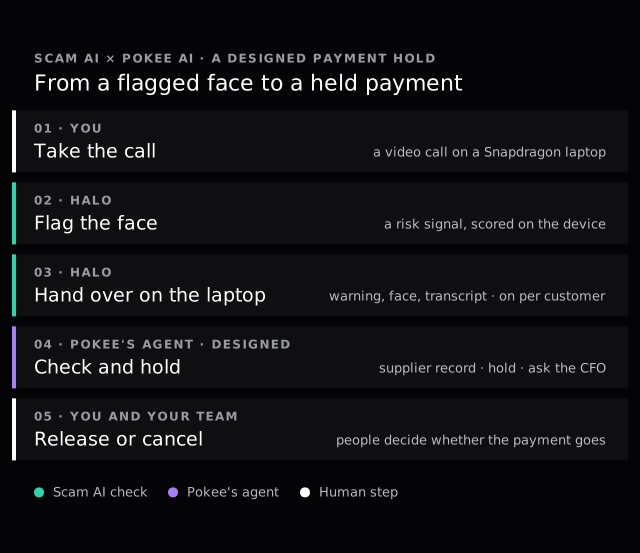
Teal marks the Scam AI check, purple Pokee's agent, white a human step.
What the hand-off carries
Halo's data stays on the laptop: detection runs on the device, and the hand-off stays there too. The agent's own actions run through systems the customer connects. Pokee lists Slack and Gmail among more than 90 integrations, and its agents can run in a customer's cloud, on premises or on the device (pokee.ai). The payables or ERP connection would be built per customer.
The hand-off gives the agent Halo's warning level rather than a raw score, with the participant's name and the face it refers to. Our reason: an agent that takes actions should branch on a decision, not invent its own cut-off on a number. The transcript lines carry their speakers, since Halo already separates who said what (Halo), so the agent sees the request in the words it was made.
The flagged face, scored, and the hold that follows
The detection half runs today, so we ran it. The sample is a crop of one of our Deepfake Playground's StyleGAN2 faces, trimmed the way a Halo warning carries a face (about the set). On 1 October 2026 (UTC), Scam AI's detection flagged it as AI-generated: fake, which our public API reports as LIKELY_AI (full response).

The agent never sees that answer as a number; the hand-off gives it Halo's warning level. Here is the rest of the demo, the designed hold, as it would run:
- Warning: deepfake, participant "CFO", the flagged face.
- Transcript line: "Pay the supplier at the new account tonight, and keep it off the thread."
- Agent: finds that the supplier's bank details changed only on this call, holds the payment in the payables system, asks the CFO on Slack to confirm and tells the controller.
FAQ
Does deepfake CFO fraud prevention work if the caller keeps the camera off? Not Halo's part: it scores faces, backgrounds and camera feeds (Halo), so with the camera off it has nothing to score. A rule that requires confirmation on another channel still applies.
Does anything leave the laptop? Not from Halo: detection runs on the device, and the hand-off to the agent runs on the same laptop.
Does the agent decide on its own? It would act within the permissions a customer gives it. People set those permissions and decide whether a held payment is released.
Is this only for CFO calls? No. Any request to move money or grant access fits: supplier bank-detail changes called in to accounts payable, urgent intercompany transfers, and closing or escrow instructions confirmed over video. Help-desk requests from a "manager" to reset someone's sign-in fit too (social engineering).
If your finance team approves payments on video calls, set up a deepfake-aware payment hold with us and Pokee.
Learn more: Pokee AI · agent security research
Scam AI × Pokee AI · 2026