

Loan stacking: controls for overlapping applications
Understand loan stacking, credit-report gaps and overlapping applications. Build a lender review that separates verified debt exposure from suspected fraud.
Contents · 10 sections
- What is loan stacking?
- Concurrent borrowing does not establish fraud
- Why a fresh credit report can leave a gap
- Build the review around borrowing events
- Preserve the event time and the observation time
- Use independent evidence to resolve the missing fact
- Reconcile the evidence before changing the decision
- An example of an alert that changes meaning
- Where document authenticity checks belong
- Give each outcome an owner
An underwriter sees several recent inquiries. Is the applicant shopping for one loan, or taking on obligations elsewhere? Online lenders and fintechs need to resolve that question before releasing funds, often using records that describe different moments in time.
A useful loan-stacking control makes those visibility gaps explicit and gives an accountable reviewer an evidence-backed basis for the next decision.
What is loan stacking?
Loan stacking means taking out multiple loans from different lenders within a short period, creating overlapping obligations. In application monitoring, the term also describes suspected overlapping borrowing that has yet to be confirmed. Keep that distinction visible: an application, an approval and a funded loan describe different states.
The concern is aggregate exposure. Each lender may assess an applicant using information that omits another recently obtained obligation. A borrower can become ineligible under a lender's credit policy even when their identity and every submitted document are genuine.
At Scam AI, our document-forgery checks address the authenticity of submitted paperwork. They support a separate part of the lending review; they do not establish the applicant's total debt or reveal loans at other lenders.
Concurrent borrowing does not establish fraud
An inquiry records a credit check, not a disbursement. The Consumer Financial Protection Bureau explains that credit-scoring models accommodate comparison shopping for loans, including mortgage, auto and student-loan shopping. Scoring treatment depends on the model and product. It does not tell an underwriter which offers became debt.
Keep the credit assessment separate from any investigation of deception:
| What the evidence shows | What the lender still needs to resolve |
|---|---|
| Several inquiries or applications | Whether any resulted in credit, and whether records describe the same financing request |
| Concurrent borrowing disclosed by the applicant | Aggregate repayment obligations and eligibility under the relevant product policy |
| Confirmed new debt that changes affordability | A revised credit decision, even if there is no evidence of deception |
| A material discrepancy between a disclosure and independently confirmed borrowing | What the applicant was asked, what was true when they answered, and whether an explanation resolves the discrepancy |
Reserve “suspected misrepresentation” for a material disclosure conflict that remains unresolved after considering source and identity errors. A policy exception, a missed payment or a burst of applications is insufficient on its own to establish intent. Contractual restrictions and legal conclusions require their own assessment of the agreement and facts.
Why a fresh credit report can leave a gap
A report obtained today can contain account information last supplied earlier. Creditors follow their own account-reporting schedules, and information can differ between bureaus. The retrieval date is not the date every account was refreshed.
Coverage is a separate limit. The Federal Trade Commission notes that not all creditors report to credit bureaus. Repeating the same query cannot make an uncovered lender appear.
This creates two different questions for a reviewer:
- Did something change after the evidence period? A statement or account record can be accurate for its period and say nothing about a later loan.
- Would this source contain the event at all? A no-match result from a limited network or report says only that no matching event was returned within its coverage.
Record the report's retrieval time alongside the account-level dates it supplies. Keep an explicit “unknown” state for missing coverage, uncertain identity matches and unavailable updates. Those states must not become “no other debt.”
Build the review around borrowing events
We recommend a time-stamped exposure record rather than a single “stacking detected” label. The record should show the lifecycle of each relevant application or obligation, plus how the lender knows its status.
Preserve the event time and the observation time
Event time is when the application, funding or repayment happened. Observation time is when the reviewing lender received evidence of it. Both matter when assessing an earlier disclosure or deciding whether a prior credit assessment is still usable.
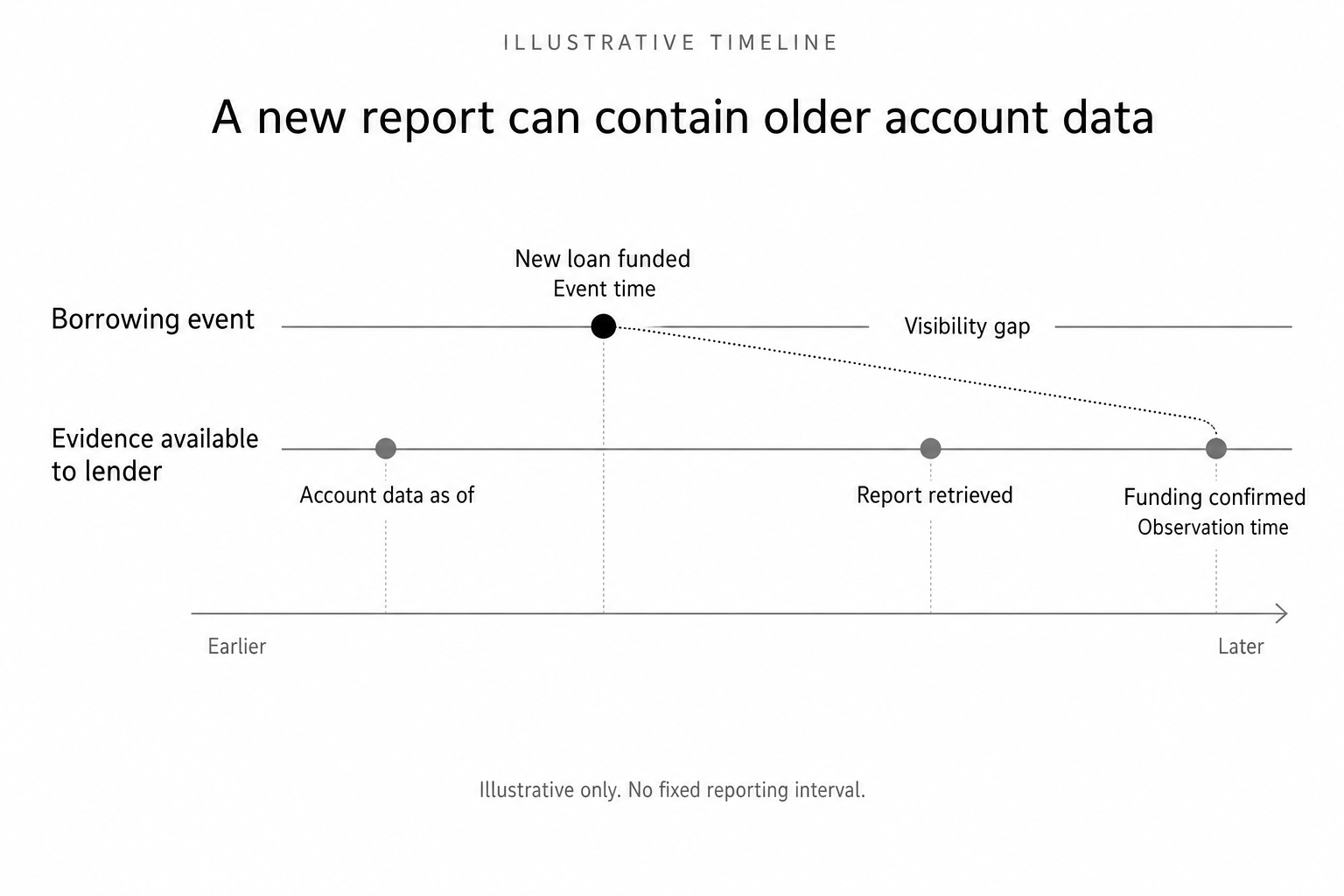
For each relevant record, retain:
- The matched applicant or business, with unresolved matching issues identified.
- The creditor and a reference that distinguishes the obligation from duplicate records.
- Its status, including applied, approved, accepted, funded, withdrawn, declined or repaid, where supported.
- The event date, source reporting date and time received by the reviewer, with unknown dates left explicit.
- Confirmed balances and required payments, plus outstanding questions and the evidence supporting each entry.
An approval may create a commitment relevant to policy before cash is disbursed. An undrawn facility can also matter. Keep these in their proper categories instead of counting every application amount as funded debt.
A lender's own application history supplies visibility within its business. It does not become cross-lender visibility simply because multiple internal records match.
Use independent evidence to resolve the missing fact
The source should fit the question. A signal that someone sought credit cannot substitute for evidence that they obtained it.
| Evidence source | Useful contribution | Limit to preserve |
|---|---|---|
| Credit reports and permitted refreshes | Reported inquiries, accounts, balances and account dates | Reporting delay, coverage and identity-matching limits |
| Authorized cross-lender application or origination data | Events reported by participating lenders | Participation, event definitions and freshness; an application event does not establish funding |
| Creditor confirmation through an independently established channel | Status, payment obligation or payoff information for a specific facility | Narrow scope; confirmation of one facility does not establish total exposure |
| Applicant disclosures and explanations | Other applications, accepted offers, recent borrowing and the applicant's account of discrepancies | Statements require corroboration where a material conflict remains |
| Permitted bank-source records | Relevant disbursements or repayments visible in the covered accounts and period | A credit entry may have another purpose; accounts, periods and obligations can be missing |
For cross-lender data, establish whether the feed records inquiries, submissions, approvals or originations. Preserve its participating-lender coverage and update information in the review record. Two differently named events may describe the same loan; two similar events may belong to different borrowers. Resolve those relationships before totaling exposure.
In US consumer lending, obtaining and using consumer reports requires a permissible purpose under FCRA, the Fair Credit Reporting Act. Cross-lender access belongs within approved data-sharing and privacy arrangements. Broad fraud-prevention language does not itself authorize unrestricted data collection or sharing.
Reconcile the evidence before changing the decision
Compare confirmed obligations with the application's actual questions and answers. A later funding event does not automatically make an earlier answer false. Conversely, a current disclosure that conflicts with an independently confirmed earlier obligation needs resolution.
Separate these questions in the case record:
- Does the outside record belong to this applicant?
- Did the event create an obligation relevant to this lending decision?
- Was that obligation already included, withdrawn or paid off?
- Does its timing change the accuracy of a disclosure or the current credit assessment?
Fannie Mae's mortgage inquiry requirements illustrate the distinction: lenders must resolve whether recent inquiries led to additional credit absent from the report or application, then verify newly obtained debt and qualify the borrower with its payment. These are requirements for the relevant Fannie Mae mortgage workflow, not a universal rule for every fintech product.
For other lending products, the credit-policy owner defines which commitments affect eligibility and when a material change requires a refreshed assessment. Before releasing funds, reconcile newly observed obligations against the approved case under that policy. A report refresh helps only within the source's coverage and reporting limits. Avoid a universal application-count threshold presented as proof of stacking or fraud.
An example of an alert that changes meaning
In this illustrative lender workflow, an application alert identifies several recent credit-seeking events. The initial label is “overlapping applications, exposure unresolved.” The records are fictional and do not represent a customer outcome.
| Record at initial review | What reconciliation establishes | Treatment in the case |
|---|---|---|
| An inquiry from another lender | The applicant compared an offer and did not accept it | Credit seeking, with no funded obligation established |
| A new loan absent from the earlier report | Independent creditor evidence confirms funding after that report's account information | Add the confirmed obligation to the current assessment |
| An old balance alongside a refinancing record | Payoff evidence confirms the old facility was repaid | Avoid counting the replaced balance as continuing debt |
| An uploaded bank statement with no forgery signal | Its period ends before the new funding event | Keep the authenticity result; do not use it to exclude later borrowing |
The new obligation can change the credit decision. Whether it also creates a disclosure concern depends on when the applicant answered and what the application asked. The inquiry and replaced balance do not become extra funded loans merely because they appeared in the same alert.
Where document authenticity checks belong
Document review helps assess the reliability of evidence used in origination. It cannot fill a cross-lender reporting gap. An authentic statement may be incomplete for the decision period; an altered statement may warrant investigation without establishing any concurrent borrowing.
Our document-forgery checks analyze bank statements, pay stubs and other supporting paperwork for tampering and AI-generation signals. Document detection is arranged with our team separately from self-serve media credits. The lender's reviewer connects the result to source corroboration and the underwriting decision.
A localized signal directs attention to a part of a file. It does not prove the highlighted region was altered. A detector score is not a calibrated probability of loan-stacking fraud, proof of intent or an overall accuracy figure. A low signal does not certify that a document is complete or that the issuer confirms its contents. Our guide to interpreting detection evidence explains how to preserve those limits in review.
For asset-backed lending, Verifit provides guided remote inspections of property, project progress and equipment. Inspection evidence remains separate from document authenticity and debt exposure. It does not establish the absence of other borrowing or competing security interests.
Give each outcome an owner
A stacking alert should lead to a defined task. Assign an owner and an evidence requirement for closing it, rather than leaving the application in a general fraud queue.
| Review finding | Next action | Accountable owner |
|---|---|---|
| Credit shopping with no additional obligation established | Resolve the alert and continue under normal policy, preserving remaining coverage limits | Underwriting or credit operations |
| Confirmed additional exposure | Reassess eligibility and document the resulting credit decision | Authorized credit decision-maker |
| Missing or conflicting evidence | Obtain the specific missing fact through approved channels and record what remains unresolved | Assigned reviewer |
| Corroborated material discrepancy suggesting deception | Escalate with the original disclosure, event chronology and supporting evidence | Fraud investigation, with legal or compliance involvement as applicable |
Route investigations alongside the applicable decision and notice workflow. For credit covered by US Regulation B, the adverse-action notification rules include a general option to give specific reasons or notice of the right to request them, with different notification mechanics for business credit. A statement governed by §1002.9(b)(2) must identify the specific principal reasons for the action. The official interpretation requires those reasons to accurately describe the factors actually considered. “Stacking score” is a poor substitute for the underlying decision basis.
Keep enough in the case file for another reviewer to reconstruct the outcome: the evidence available at decision time, later corrections, the policy applied and who authorized the action. Preserve the difference between “not observed,” “confirmed exposure” and “suspected deception.” Each describes a different evidentiary position.
If suspicious paperwork is the unresolved part of your lending workflow, request a demo of our document-forgery checks and bring a representative intake case. We can show where authenticity evidence fits alongside your existing credit checks and accountable review.