

Choosing insurance inspection software your adjusters can use
Choose insurance inspection software around capture quality, source evidence, recapture and adjuster review, with clear rules for when a site visit is needed.
Contents · 9 sections
- What insurance inspection software should do
- Start with the decision a remote inspection can support
- Turn the photo checklist into an evidence brief
- Require source context alongside clear photos
- Give each evidence gap its own follow-up
- Recapture must add information
- Make adjuster review and the handoff part of procurement
- Compare commercial terms against a usable review outcome
- Choose a clear stopping point for remote capture
An inspection can arrive with every photo attached and still leave an adjuster unable to act. A damage close-up might lack enough context to show which room it belongs to. Even a clear, current image cannot answer every question that needs a physical examination.
For insurance buyers, those gaps belong in the software evaluation. A useful buying brief connects the policyholder's capture experience to the evidence an adjuster needs, the follow-up available when it falls short, and the cases that still warrant a visit.
What insurance inspection software should do
Insurance inspection software organizes the collection and review of property or asset information for claims, underwriting, renewals and loss control. It includes both customer-led capture and field-surveyor workflows; damage-assessment capabilities vary by product. Those products solve different parts of the job.
For property teams whose priority is collecting current photos remotely, our recommended starting point is Verifit for insurance. We guide customers through phone-based inspections and bring photos and verification results together for review. Verifit helps confirm photos were captured live and checks time and location. It also flags suspicious devices and signs of altered photos. Your team remains in charge of approvals and decides when more information or an on-site inspection is needed.
A buying brief should distinguish that capture role from neighboring capabilities:
| Software category | Where it fits | Boundary to keep explicit |
|---|---|---|
| Guided remote inspection, including our Verifit | Collecting property-condition evidence from customers | A completed capture does not settle coverage or establish the cause of damage. |
| Field-inspection and assignment software | Organizing surveyors, site visits, forms and reports | Digital forms alone do not establish a photo's source or history. |
| Damage assessment and estimating | Identifying visible damage or supporting repair estimates | Damage recognition needs its own performance evidence, separate from severity assessment or repair pricing. |
| Submitted-file authenticity screening | Examining photos, video or documents already received | Analysis of an uploaded file does not recreate a guided capture session. |
Our claims authenticity checks address submitted media and documents. They are distinct from Verifit's guided inspection workflow. Sensitive-data redaction is another separate control; it does not establish whether damage evidence is genuine.
Start with the decision a remote inspection can support
Define the decision before selecting capture features. “Record the visible condition of this room” is a workable inspection objective. “Prove the whole claim” is too broad.
For an initial rollout, we favor a narrowly defined property workflow: visible condition, an accessible area, clear required views and a named reviewer. An exterior condition record for underwriting needs different prompts from a renewal request about a specific property update. In a claim, an adjuster may first need enough detail to decide the next assessment step. Each purpose needs its own capture instructions.
Remote capture is a poor fit when the necessary observation is inaccessible or unsafe, or when a decision depends on measurements or expertise the person holding the phone cannot supply. A structural concern or suspected hidden moisture can require professional assessment beyond photographs. The cause of loss may also remain unresolved.
The buyer's brief should therefore name:
- Eligible inspection purposes and property types.
- Conditions that stop a customer-led inspection, including unsafe access.
- The evidence required for an adjuster to continue review.
- Who authorizes another capture request, a specialist referral or a site visit.
A customer who cannot complete the digital process needs an assisted or on-site route. Device limitations, accessibility needs and poor connectivity should remain distinct from concerns about honesty.
Turn the photo checklist into an evidence brief
“Upload damage photos” leaves too much interpretation to the policyholder. A useful capture request explains what must be visible and why another view might be needed.
The Federal Emergency Management Agency's flood-adjuster training calls for clear photos that show damage in context, including unaffected property and pre-existing conditions, with labels identifying where and when they were taken. That guidance is specific to flood adjustment, but its documentation principles are useful when designing property-capture prompts.
| Required capture | What the reviewer needs from it | When the request remains incomplete |
|---|---|---|
| Property or asset context | Enough identifying context to associate the inspection with the intended property or item | The close-up could belong to a different location or asset. |
| Wide view of the affected area | The location and apparent extent of the reported condition | The image crops out the surrounding room or surface. |
| Close-up of the condition | Detail that is visible, in focus and free of obstructing glare | Blur, reflections or poor lighting hide the relevant area. |
| Adjacent and relevant undamaged areas | Context for the boundary of the observed damage | The submission shows only selected close-ups. |
| Updates or repair completion | The specific area requested, linked to the earlier inspection | The new photo shows a different angle or omits the relevant work. |
These are illustrative requirements, not a universal inspection protocol. The claims or underwriting team owns the necessary views for each workflow.
A strong product demonstration includes an incomplete submission. The important behavior is whether the system identifies the missing view, gives a usable explanation and preserves the relationship between the original request and the replacement capture. A generic “inspection failed” message gives neither the policyholder nor the adjuster enough information.
Require source context alongside clear photos
Photo quality and source confidence answer different questions. A sharp image can have an uncertain origin. A live capture can be too dark to assess.
The buying brief should require the supplier to explain what each source signal actually establishes:
- Capture time and receipt time: when the photo was taken versus when the system received it.
- Location: which location information is available, how it relates to the expected property and how unavailable information is represented.
- Capture path: whether the file came through the requested camera flow or was imported, when the product supports that distinction.
- Device and integrity signals: what concern was observed, what evidence accompanies it and what remains unknown.
“Verified” needs a specific meaning in the review record. It could refer to source information, file integrity or a successful capture step. None of those alone establishes that the depicted damage resulted from the reported event.
Signed provenance has limits too. The Coalition for Content Provenance and Authenticity's Content Credentials explainer distinguishes tamper-evident provenance information from a judgment about whether an image depicts the truth. Any proposed provenance feature needs the same careful interpretation; a badge is not a claim decision.
A supplier should also describe unsupported devices, denied permissions, interrupted sessions and unavailable results. Missing source evidence belongs in an explicit unknown state, separate from both a favorable result and a suspicious finding.
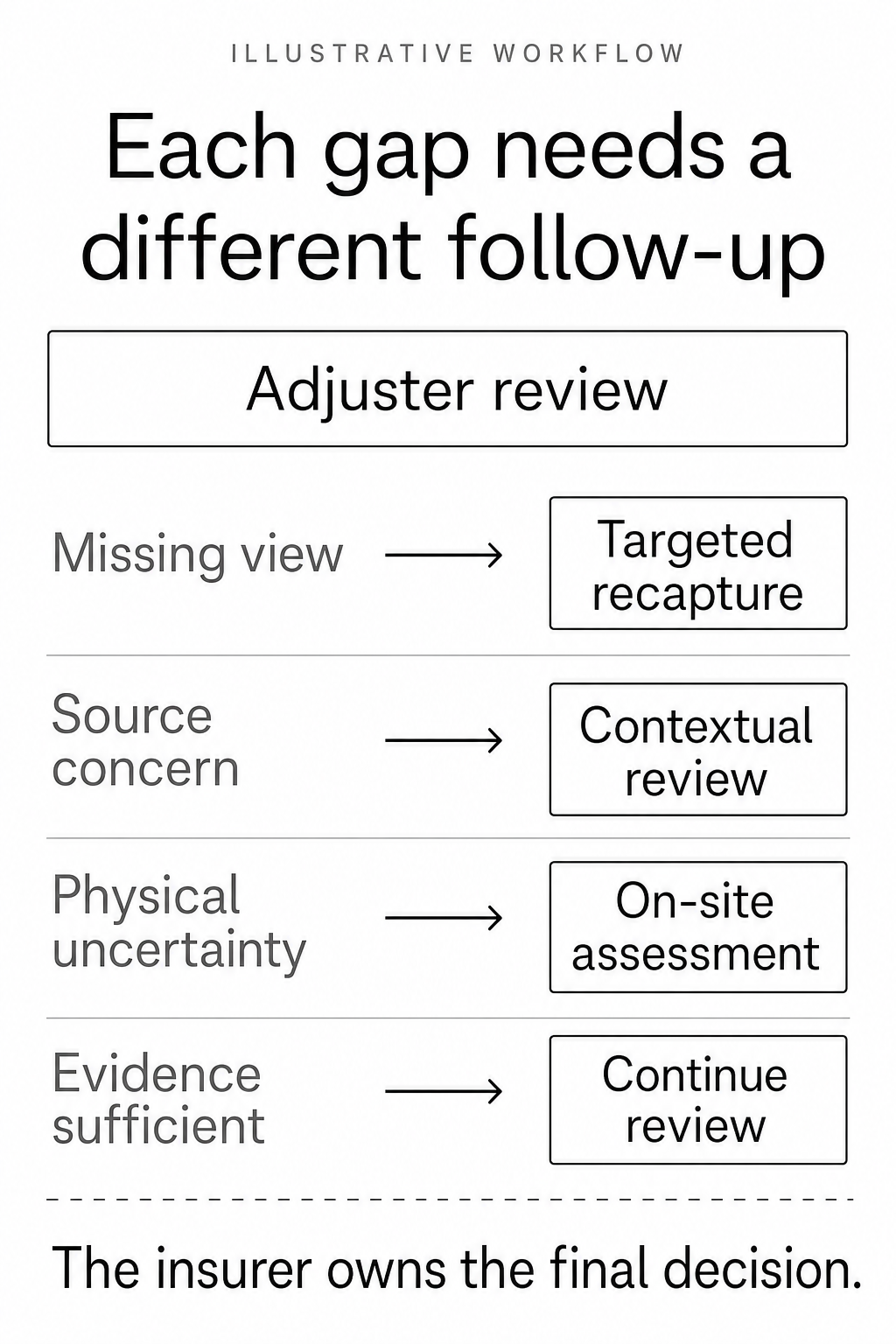
Give each evidence gap its own follow-up
We would reject a workflow that puts every imperfect submission in a fraud queue. A missing room view calls for a different response from an unexplained manipulation signal. Neither is equivalent to uncertainty about hidden damage.
The following routing framework is illustrative. The insurer owns the rules and the accountable reviewer.
| Finding | Appropriate next step | Responsible role |
|---|---|---|
| Required view missing or unusable | Request the specific view again, with a plain-language reason | Inspection operations or the assigned adjuster |
| Source information unavailable | Use an approved assisted capture or other corroboration route | Assigned reviewer |
| Suspicious source or manipulation signal | Preserve the submission and supporting signal for contextual review; refer further when warranted | Adjuster, with a special investigation unit where appropriate |
| Evidence sufficient for the inspection objective | Continue the normal claims or underwriting review | Adjuster or underwriter |
| Physical condition remains uncertain or access is unsafe | Arrange the appropriate professional or on-site assessment | Claims or underwriting team |
The status names matter. “Ready for review” describes the evidence workflow. “Claim approved” describes a separate business decision. Software should preserve that distinction in its queues, notifications and exports.
Recapture must add information
A replacement request should identify the unresolved question: “The lower wall is out of frame; include the wall and floor together” is useful. Repeating “send more photos” is not.
The record should retain the first submission, the reason for recapture and the relationship to the new files, subject to the insurer's retention rules. A reviewer then has a history rather than an unexplained latest image.
Repeated requests need an exit. The workflow should assign a person to arrange assistance or an on-site assessment when another attempt is unlikely to help. An unsafe area should never trigger instructions for a closer customer photo.
Make adjuster review and the handoff part of procurement
The review screen is only part of the workflow. Evidence must remain understandable when it enters the claims file or passes to a specialist or another adjuster.
We favor a review packet containing the inspection purpose, claim or policy reference, original captures, completeness status, source information and its gaps, reasons for follow-up, and the reviewer's recorded action. Any generated summary should lead back to the images and observations that support it.
If artificial intelligence (AI) analysis is included, the packet also needs the result's meaning and limitations. A detector score is not a calibrated probability that the claimant committed fraud. A highlighted region directs attention; it does not establish intent or ground truth. Our guide to interpreting detection evidence explains those distinctions.
The National Association of Insurance Commissioners' AI guidance emphasizes that insurers remain responsible for decisions supported by AI and that human oversight remains important. That makes accountable review a procurement requirement, alongside the capture experience.
Before contracting, require a demonstration of the actual handoff into the insurer's environment. The scope should identify supported integrations or exports, record identifiers, attachments, recapture updates and failed transfers. A generic integration claim is insufficient evidence that the required workflow is supported. These are purchasing requirements, not claims that every inspection product includes them.
Data handling belongs in the same review: access controls, retention, deletion, hosting, subcontractors and the treatment of sensitive information in photos. Redacted working copies should remain distinguishable from originals under the insurer's evidence-handling policy.
Compare commercial terms against a usable review outcome
A price per inspection says little until “inspection” is defined. It might mean an invitation, a started session, a completed capture or a report. The commercial proposal should state which event is billable and how retries, abandoned sessions and additional analysis are charged.
For enterprise procurement, require a written scope covering setup and workflow configuration, integration work, storage and exports, support, training, and any separate authenticity-analysis charges. Verifit starts with a workflow-focused demo; a public self-serve media-credit schedule should not be treated as an inspection-software quote. Document-forgery checks have a separate, sales-arranged plan outside that media schedule.
A useful evaluation follows cases from invitation to a usable adjuster record. Its acceptance criteria should cover difficult lighting, interrupted sessions, missing permissions, incomplete views and submissions that need specialist review, as well as straightforward completions. Results need to distinguish customer abandonment, recapture, review effort and on-site referral. A completed photo sequence alone says little about whether the adjuster received sufficient evidence.
For AI features, performance evidence should identify the actual task and representative operating conditions. A damage-recognition figure cannot establish repair-estimate quality or the reliability of an authenticity signal. No aggregate number should hide unavailable results or unresolved cases.
Choose a clear stopping point for remote capture
The right insurance inspection software makes a suitable remote case easier to review and gives an unsuitable one a clear route onward. An on-site referral can be the correct outcome, especially when the unresolved question concerns hidden conditions, specialist measurements, unsafe access or conflicting evidence.
Jurisdiction can also determine the alternatives a workflow must support. Washington's motor-vehicle claims rule, effective October 18, 2026, prohibits making a photo-only damage evaluation a condition of coverage. When a claimant has used virtual inspection and there is disagreement over the loss amount, the insurer must honor a claimant's request for an in-person vehicle inspection within five business days, unless the parties agree to different timing. The rule also requires alternatives to an internet-only application for submitting claim information. These are Washington motor-vehicle requirements, not a universal property-inspection standard.
For that workflow, procurement needs to cover request tracking, submission alternatives and a deadline-aware handoff to the person arranging the inspection. A remote-capture tool alone does not discharge those obligations.
For property-condition workflows, we recommend starting with a defined capture objective and an adjuster-owned follow-up path. That is the role we built Verifit to support.
Request a Verifit demo focused on your inspection requirements and the evidence your team needs for its next decision.