

Updates ·
Helping an attorney challenge AI-generated evidence
Scam AI's forensic report and expert affidavit helped an attorney challenge a custody-case photo. She later reported success at a contempt hearing.
Before a young child could stay overnight at his father's home, the court required a recent photograph of the stairs. The photo was meant to document a safety condition. It became the evidence in dispute.
Scam AI cofounder Dr. Ben Ren examined the file and documented evidence of AI generation or manipulation in a forensic report and expert affidavit. The mother's attorney used those materials to challenge the photo, and later reported success at a contempt hearing.
AI-generated editorial illustration. The disputed photograph is not reproduced.
The case at a glance
- The challenge: establish whether a staircase photo submitted in a custody matter was authentic.
- Scam AI's work: expert examination, documented findings, a forensic report and an affidavit.
- The use: supporting exhibits for the attorney's motion challenging the image.
- The result: the signed order addressed altered pictures; the attorney later reported a successful contempt hearing.
A photograph with consequences
The court's requirement concerned a real home and a child's overnight visits. If the submitted image had been generated or materially altered, it could not establish what the stairs actually looked like.
The attorney needed a documented basis for challenging the file. Ben's examination addressed that question: what did the file reveal about how the image was made?
Three findings the attorney could point to
The motion summarises three findings from Ben's examination:
- Metadata identified a model. The file attributed the image to OpenAI's GPT-4o.
- A signed credential recorded AI origin. The file contained a cryptographically signed C2PA record.
- Independent detectors supported the conclusion. Multiple detection systems flagged generation or manipulation with high confidence.
Together, these gave counsel specific findings to cite: a model identifier, a signed provenance record and corroborating detection results. The examination addressed the image's authenticity; assessing the safety of the actual staircase was a separate question.
From findings to a court filing
The motion referenced Ben's expert affidavit and forensic report as supporting exhibits. It set out his findings and asked the court to exclude the image.
The report organised the technical findings. The affidavit supplied the expert's statement. Counsel could bring both into a filing and explain the basis for the authenticity challenge.
The signed order and the attorney's feedback
Three days after the motion was filed, the judge signed a ruling on its first page:
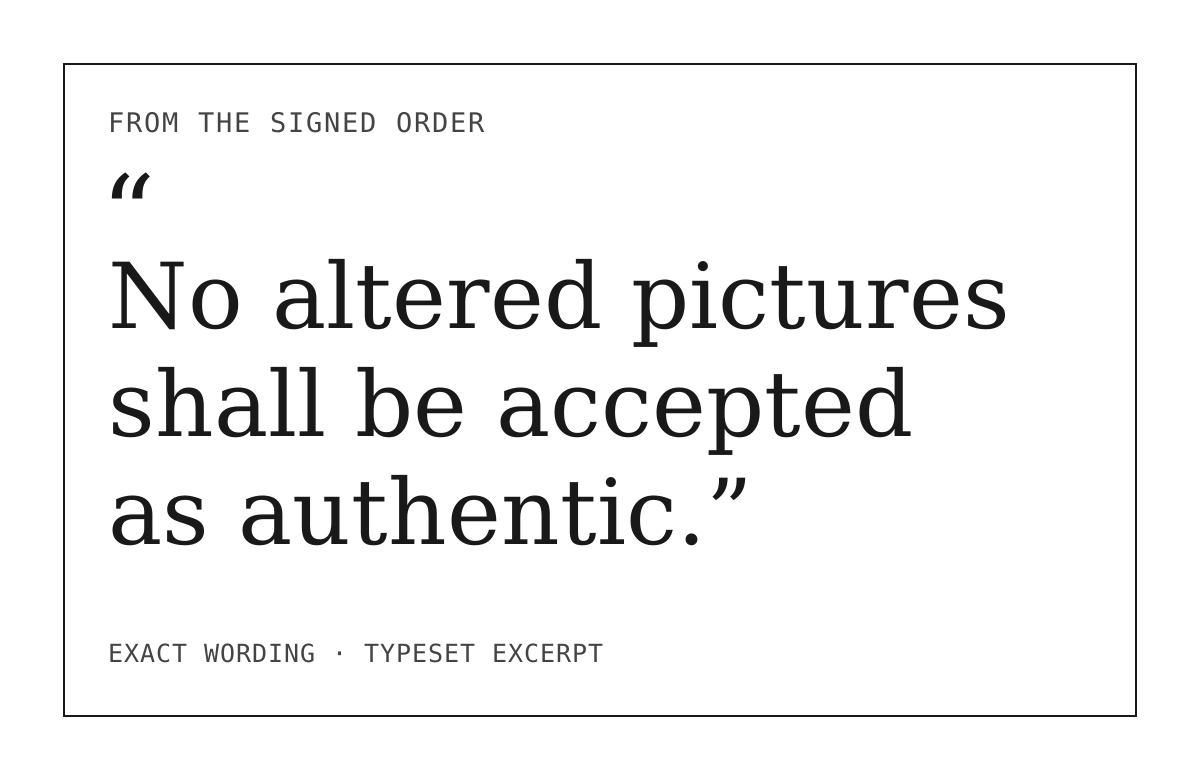
Exact wording from the signed order, typeset for this article.
In a later message to Ben, the attorney said the memo, his report and affidavit had been used in a contempt hearing concerning the submitted AI image. She wrote:
We were successful in the hearing.
— Attorney in the case, in written feedback to Ben
These are two distinct records: the signed order and the attorney's later account of the hearing. The order does not explicitly admit the report or decide the wider custody case.
What this means for legal teams
For counsel, the practical value was a documented basis for challenging an image: what the file revealed, who examined it and why the findings mattered. Scam AI's work gave the attorney material she could use in proceedings.
This account is based on the signed filing and the attorney's written feedback. Family and case identifiers are withheld.
Need an image examined?
Send the earliest copy you have, how you obtained it and your deadline. We can discuss the examination and documentation your matter needs.